Wednesday, April 29, 2009

fascists...monkeys....explosions...more fascists....


one of the first things that came to mind when watching this film was why haven’t i seen it before? i remember vaguely hearing about it some time ago, but now that i’ve finally seen it, i’m really surprised that i haven’t heard a lot more about it. not only did “underground” win the palme d’or at cannes in 1995, but it is a seriously beautiful, passionate, moving film.

directed by emir kusturica, the story begins in 1941. although yugoslavia is starting to feel the encroaching war, best friends marko and blacky don’t initially seemed deterred from a hedonistic life of smuggling and generally bad behavior. marko is the suaver of the two, with a twiddly little mustache, who cheerfully visits prostitutes and gets off on bombing raids. blacky, the more heroic of the two, cheats on his pregnant wife vera with ditzy actress natalija. the real trouble starts when the war gets closer and marko falls for natalija. through a wacky chain of events involving an interrupted play, an forced almost-elopement, and a nazi raid, marko shuttles an injured blacky, vera, his brother ivan, and ivan’s chimpanzee soni (a long story involving a zoo) to safety with a group of workers at an underground munitions factory. the group seems fine with the idea of waiting out the war, stirring their fever for their homeland as they continue to manufacture arms and live their lives, with an awful lot of partying accompanied by a raucous brass band. the only problem is that marko, having confessed his love to natalija, isn’t compelled to tell them once the war has ended, and keeps up the charade that the danger of the lurking fascists is ever-imminent. he keeps this up for twenty years, during which time he becomes a poet, natalija’s husband, and, oh yes, one of tito’s chief advisors.

i’m not even scratching the surface of the plot here. i mean, the movie does clock in at just under three hours, which is probably my only possible complaint. the whole film is soaked in this bizarre sort of magical realism, actually quite reminiscent of jonathan safran foer’s novel ‘everything is illuminated’ (but not the movie; the movie was largely crap save the supporting role from the lead singer of gogol bordello.) there is a bride who jumps into a well and swims into a lake, the aforementioned monkey, soni, who lives alone underground for twenty years (this scene of monkey/human reunion is way better than the end of “project x’, my previous standard for emotional scenes with animals), and a father who keeps asking if anyone has seen his son, who drowned decades before. and while the film doesn’t break with this magical realism, it turns from the wild, whimsical aura of the first half of the film to horror-fraught scenes of the yugoslav wars in the nineties. there is a viscerally powerful scene involving a wrecked statue of christ crucified upside down while a motorized wheelchair containing two flaming human bodies runs in circles around it. not sure I’ll be able to forget that one.

and yet, somehow, the movie manages to end on an upbeat, if wistful note. this is really an incredibly enjoyable film, which is saying something for a film that has some fairly gruesome depictions of war. the last scene is tremendously beautiful, all the more so as the characters are celebrating a place which no longer exists outside of their memories.

p.s. the film is accompanied by a fantastic score by the fantastic goran bregovic, who also did the score for 'la reine margot', which, like with that film, makes me want to go out and buy all of his cds.

Wednesday, March 4, 2009

matthieu amalric and i are practically twins.


well, sort of.

in olivier assayas' dreamy 1999 film, 'fin août, début septembre', amalric briefly holds down a job coordinating the publication of an encyclopedia, just like me! okay, so mine have to do with science, his has to do with literature. i have a cubicle, he has an office. but really, nearly twins.

amalric plays gabriel, a chronically out-of-work aspiring novelist who doesn't seem to write all that much. drifting between his ex, jenny, and the somewhat more exciting anne, he seems fairly aimless until his good friend adrien (francois cluzet), a moderately successful writer, begins to suffer from a never-named disease. not that gabriel ever becomes that much less aimless, mind you, but he does seem to realize over the course of the film that sometimes decisions have to be made, and made by him.

cluzet's adrien is darker and more disturbed than i've seen him, even more than in last year's wonderful 'tell no one'. but assayas doesn't delve too deeply into his character. although if you think about it, he doesn't really delve too deeply into anyone's character, which is really what gives the movie a presence that is different than most. early on, an interviewer is expressing his views over adrien's novels, commenting that the problem is that there's really not much of a story to any of them. gabriel replies that real life isn't so much stories anyway. and he's right. people are so often obsessed with movies being two hours of non-stop event, and that honestly doesn't resemble life at all. in this way, the film really was reminiscent of assayas' earlier film 'clean', starring maggie cheung, in that you have people wrestling with these huge issues (addiction in 'clean', love and death in 'fin août') and although these thing obviously have tremendous impact on their lives, there are still such a lot of in between moments when you're just left without an awful lot going on.

apart from amalric, the rest of the ensemble cast was great. although, virginie ledoyen seems a little young and a little hysterically beautiful for gabriel's restless vaguery. and a small subplot involving adrien and his fifteen-year-old lover was more than a little icky.

i was...mildly disappointed in the ending. but that may just be a girly hope that gabriel would choose the less attractive girl. but he didn't, and i still work in a little cubicle with piles of scientific encyclopedias.

Sunday, February 22, 2009

oh, anthony.


i was sitting on the a train today for what seemed like years, and i suddenly noticed a smell that made me think instantly of someone, but i couldn't remember who. after concentrating for a few minutes, i realized that it smelled of my friend anthony, whom i haven't seen in, oh, ever so long. it smelled of him, of his parents house in kilkenny where i spent the night after the halloween party, where we stayed up until 4 eating bananas and frozen pizzas. it smelled like his clothes in the back of the tiny theatre. i never liked the smell. i always thought that it was a drawback, just a funny, slightly sour, pungent smell. maybe it was his hair gel? i don't know. but i remember not liking it.

but today when i smelled it...i wanted to chase it around the subway car, pounce on it and force it into a jar so i could keep it with me. in the film "the holy girl", amalia takes shaving cream and rubs it into the fabric of her collar, periodically sniffing it. i wish i could have done it with that smell. and i don't know where it came from today -- was it the wet? does anthony really smell of rain?

anthony was my best friend for a short period of time. it's been five years since i've seen him, at least one since we've talked, and then only via email. it's not that we had a fight, or decided we didn't really want to be friends. sometimes you are just no longer friends with someone and that's just the way it goes. maybe it wouldn't work to stay friends with everyone anyway. it's just one of those things, but it doesn't mean that i love him any less. it's sad, but it's not. he was a time in my life, a time and a smell. and i'm happy enough to just remember what a time it was.

i don't know where anthony is now. last time we talked i think it was oxford. he won't read this. but i hope someday soon he might come across something that reminds him of me. and that will be enough.

Thursday, December 11, 2008

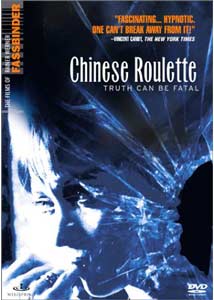
well. that was….german.


fassbinder’s 1977 film ‘chinese roulette’ just seems so stereotypically german in all of its wackiness. the plot hinges on angela, a sickly, handicapped, diabolical teenager with ringlets and a hint of a mustache over her weird mouth. she thinks her parents hate her, and she’s probably right. i think most parents would. not because she’s handicapped, but because she’s trying so hard to wreak havoc. she also has a ridiculous army of baby dolls that she takes wherever she goes.

over the course of a weekend, angela, aided and abetted by her governess, traunitz (a mute who likes to dance around on angela’s crutches, naturlich), conspires to bring together her parents (a weaselly little father and a dominatrix like mom) and their respective lovers (anna karina with too much eye makeup and a sleazy businessman) for fun and games at their mansion in the country. rounding out the party are the housekeeper, kast, who refers to angela as ‘the nasty little cripple’, and her son gabriel, a creepy man-child who may or may not write long boring treatises on anarchy, but who definitely likes to bite traunitz’ neck. after an initial moment of awkwardness, the parents accept the situation quite jovially, although their paramours never quite seem to settle into the diabolical spirit of things. and so the weekend goes, with everyone either kissing gratuitously or shooting daggers of hatred from their eyes. or both at once.

it is angela who runs the show. although no one except traunitz likes her, they all seem terrified of her, and go along with anything she says. chinese roulette seems to be a family game, although i’m pretty sure i remember playing it in drama school. angela divides them into two teams, quite obviously those she likes and those she doesn’t. one team decides on a person from the other team, and that team has to determine who it is through a series of questions, like what coin would this person be, or, my personal favorite, who would this person have been during the third reich?

the movie was very nice to look at. the austerity of the mansion was a surprise for people who obviously live such grossly indulgent lives in an emotional sense, and it was a nice contrast. and the ending, well, i certainly didn’t see THAT coming.

Sunday, November 30, 2008

paris sure was dreary in the 80s


although i suppose that could have just been from roman polanski's viewpoint.

'frantic', 1988, starring harrison ford, betty buckley, and emmanuelle seigner in her debut role, is the story of a doctor and his wife visiting paris for some sort of medical conference, although they never actually make it there. shortly after checking into a ridiculously grey hotel, they realize that the wife has accidentally picked up the wrong bag at the airport. she steps out of the room while he's in the shower, and never comes back, which is kind of an awkward thing to have to report to the hotel management. paris seems to be full of unflappably unhelpful people, from dominique pinon, who wants cigarettes or cash in exchange for information, to john mahoney as a supremely uninterested embassy worker. harrison has cottoned on to the fact that she's been kidnapped, although no one seems to care or indeed believe him. the pace picks up once he's met the real owner of the suitcase, michelle (seigner, who dresses like a member of the village people.) it turns out, yes, she was kidnapped, by a bunch of arabs who wanted what michelle was smuggling in the suitcase, which is some sort of nuclear detonator.

it was all just a bit...slow. michelle makes some half-assed attempts to seduce the good doctor, who responds just as half-heartedly. betty buckley should consider herself lucky that she got to be kidnapped and excused for most of the film. the odd thing is, it really all should have been very exciting, it just...wasn't. even the ennio morricone soundtrack was flat. and to be honest, he never really gets all that frantic....

Wednesday, November 19, 2008

that was just...unimaginably bad.

i can't even muster the adjectives to express my dislike for "the pillow book". granted, i wasn't that keen on peter greenaway to begin with. but when a movie is so god-awful boring that even ewan macgregor prancing about naked can't inject a little life into it....it certainly wasn't improved by generous helpings of vivian wu's incredibly grating narration. characters devoid of personality. painfully 'artistic'. and even though it was touted as being overtly sensual, all i wanted was for it to end. i won't even dignify it with a picture.

Sunday, November 16, 2008

"when you're in love with a married man, you shouldn't wear mascara."


and that's just one of the fabulous lines from "the apartment"; no no, not the freaky french film with vincent cassel, which i nevertheless enjoyed, but the 1960 billy wilder gem starring shirley mclaine and jack lemmon. i've meant to see this for ever so long -- i had an ex who had the poster in his apartment, and my mom always talked about it as something that she and my dad liked. so, happy birthday daddy.

poor pathetic jack lemmon (is it just me, or does he have an air of camp that he just can't seem to shake?) is bud, who works as an insurance drone. he's hoping to move up though, and gets himself on the fast track by renting out his apartment (85 dollars a month in manhattan!) to various higher-ups in the company for quick indiscretions. apparently all of the top insurance men in the 50s ran around on their wives. kind of magnifies ones loneliness when you have to wait in the rain for someone to finish having sex in YOUR apartment. and you have to clean up, too. he's a bit of a pushover. it becomes apparent that the object of his affections is one fran kubelik, sassy elevator girl in his office building. i think i would have liked to be a sassy elevator girl, actually, especially in an era when men in suits would make quips like "would i like to get her on a slow elevator to china!"

everything seems to be moving sweetly, if slowly, in bud's favor, until it turns out that fran was actually AT bud's apartment with a certain mr. sheldrake from personnel, the very night that she was supposed to be at 'the music man' with bud, with tickets given to him as a bribe BY mr. sheldrake. how sad to be stood up at 'the music man'. but yes, mr. sheldrake is played by fred macmurray -- macmurray and lemmon...not much of a choice with the two of them. sheldrake is an absolute cad, actually giving fran a hundred dollars as a christmas present. and this is where things take a surprising turn -- fran attempts suicide in bud's apartment. after the initial scare and a visit from the doctor next door (who's annoyed at what he thinks is bud's caddish behavior -- "buy now, pay later, diner's club!"), the whole thing is sort of glossed over -- no ambulance, no one refers her to a therapist. her patheticness starts to match bud's, with great lines like "i wonder how long it takes to get someone you're stuck on out of your system." me too, sister, me too. fran, rather stupidly, decides to forgive sheldrake for his philandering ways, and what with the fact that his wife chucks him out, prompted by the delightfully nosy and vengeful secretary, the two seem to be ending up together when fran finally comes to her senses. i think one of my favorite things about this movie is that there's no big kiss at the end. the romance is clinched with a game of gin rummy.

Thursday, November 13, 2008

“everybody has a box.”


this line is spoken by the more attractive but morally seedier of two main characters in christopher nolan’s 1998 film ‘following’, and he refers to a little box of photos and mementos that everyone supposedly has. the two characters, bill and cobb, know this because they are burglars. sort of. bill is a greasy unemployed writer who is so bored and lonely that he starts following random strangers. cobb is a well dressed stranger who notices and confronts him, and it turns out that cobb likes following people too. they start breaking into apartments and houses together, not even necessarily to steal, but to mess things up a bit, for instance, cobb steals lingerie from one apartment and leaves it in another. cobb doesn’t seem like a very nice man. bill’s just pathetic and goes along with it, even helping cobb break into his own apartment, which makes him seem even more pathetic than usual. this is all very well and good until bill meets an odd blonde and it all goes to hell in a handbasket.

the style of the film is very much like that of ‘∏’, albeit less twitchy. black and white, I think the word ‘spare’ sums up the atmosphere pretty well. it’s pretty painfully low-budget, but that wouldn’t really matter so much but for the fact that the acting is just not particularly good. the flash-forwards and backs are hard to follow, and you can only really tell because bill gets a haircut halfway through the film. you really shouldn’t base a timeline on a haircut. the story, though, is very good, with a couple of terrific twists, although you can see the last one coming just a bit too soon. more than anything, this film seems like a dry run for ‘memento’…..

Tuesday, November 11, 2008

"nor was there any escape from the horror of my decayed teeth."


what a line! really, if you didn't know that jane campion's 1989 film "an angel at my table" was based on autobiographies before you'd seen it, you'd have a hard time believing it.

new zealand author janet frame lived a life out of a tragic novel. the first part of this three part film is frame growing up in poverty with a mass of siblings, unpopular, desperately unattractive, a fat, rather filthy little girl with an amazing cloud of red hair. very quickly she latches onto poetry and fiction as refuges from the world, both reading and writing them. even though friends are scarce, she's not unhappy in her jolly, if weird, family. the tragedy begins when her older sister drowns, and builds in the film's second part as frame heads off to university. social graces are not her strong suit, and feeling cornered as she heads into a teaching career, a professor is alarmed at a short story she writes detailing how she got out of a sticky situation by making herself sick. very quickly she is cajoled into a psych ward, and then taken to a mental hospital that doesn't joke around, doing electroshock therapy in the open ward. she's slapped with a diagnosis of schizophrenia, and it's around this time that another sister drowns. the next eight years and 200 electroshock treatments were enough to make her crazy if she wasn't before. the film's a bit hazy on the details of how her short stories are published and win a literary prize, but they're enough to save her from invasive surgery, and she's soon sprung from the hospital.

somehow, the third part seemed to me the saddest, although it's when she travels to europe and begins to receive some real notoriety as an author. but it's only too evident how much was taken away from her, she cries at the slightest provocation, and you want to look away every time she faces a new social situation, because you know it's going to be cringe-inducing. somewhere in all of that it's decided that she was never schizophrenic to begin with. the movie ends with janet living in a tiny caravan out the back of her sister's house. it doesn't seem enough. but i suppose some lives are like that.

the film is visually sumptuous -- it's a shame new zealand is so far away, it's awful pretty. the trio of actresses playing janet are spot-on and there are seamless transitions from one to another, although the youngest janet you want to hug, and the oldest janet (kerry fox), well, you want to hug her too, but you'd also just like to cross the street.

ultimately, it's a fascinating story, and that's what makes the film.

Friday, November 7, 2008

“business or pleasure?” “oh, yes.”


the first thing i noticed about ‘hopscotch’ was what a strange little cast it has. maybe it didn’t seem so in 1980, but looking at it from 2008, it’s hard for me not to associate each actor with a distinct character that they subsequently played, or played before, but i had to catch up, being only 2 in 1980. there’s walter matthau, who just screams ‘hello, dolly!’ (yes, i watched too many musicals as a child.) herbert lom can’t be anyone by inspector dreyfus from the pink panther movies. i kept expecting a very dapper young sam waterston to start blustering his way through a death penalty case. glenda jackson i think i’ve only ever seen in ‘marat/sade’, which actually goes nicely with the shivers that i get whenever i see ned beatty. ‘deliverance’. shudder.

it’s sort of a dippy little story, with matthau as miles kendig, a cia field agent whose renegade ways have relegated him to desk duty until retirement. rather than take that, he immediately mixes up some files (should it be that easy to screw with things in the cia file room?) and heads for salzburg, where his mannish (sorry, glenda, but it’s true) lady-friend waits with her guard dog. someone mentions off-hand that he should write his memoirs, so he immediately dashes them off and sends them chapter by chapter to the cia, fbi, kgb, and any number of other international covert agencies that identify themselves with initials. the rest of the film plays out as a cat and mouse game with matthau merrily dropping clues across the world that a whole slew of bumbling agents just can’t seem to pick up in time to catch him.

walter matthau is pretty cute, in his crusty, hunch-back, droop-eyed way. he seems to be having such an awfully good time. final verdict is that it’s a pretty goofy little movie, but very charming, and if ned beatty didn’t keep dropping the f-bomb every five minutes (why is he the only one swearing?) then you could even watch it with your mom.

Sunday, November 2, 2008

as my social life hasn't exactly been at fever pitch...


...i watched 5 movies this weekend. it's a little sad, i know. first was 'get carter'. although i was not personally a fan, a little too brown and grey and not as good as 'the long good friday', i think i can safely say that this is the type of film that guy ritchie has consistently found himself unable to make. he keeps tryin', though.

second was 'band of outsiders', which has already had quite enough written about it, so i'm not going to try and add anything other than the fact that i thought it was sublime, especially the dance scene in the bar.

the third film i mightily regret, and wish i could get my twelve dollars back. i should have known, reading the overly effusive new york times review of 'synecdoche, new york', that something was up. namely the fact that i'm not sure the reviewer and i even saw the same film. i mean, it started out so strong, but just disintigrated into being painfully pleased with itself. there were some great moments, most notably tom noonan's final lines, but seriously. i was in pain by the end. you want to like it, you do. but all of the characters were reprehensible and spent all of their time making pretentious dialogue and navel-gazing. it leaves a bad taste in your mouth. and your wallet.

the fourth was a surprise. i'd just happened to read a blurb on 'dear zachary' and decided to see it. the thing is, i have only ever cried at one movie, and, given the number of movies i've seen, that's impressive. or maybe i'm just a cold fish? (that one movie was 'broken english', with a screechy parker posey and a mouth-watering melvil poupaud -- there's a scene when a fortune teller calls after posey's character "your father misses you." her father was dead, my father is dead, and i completely lost it.) this is not to say that i cried at 'dear zachary'. i was wearing a ridiculous amount of black eyeliner and mascara, and the ensuing scene wouldn't have been pretty. but i certainly had to fight it. it was one of the most depressing things i've seen in a long time -- a filmmaker sets out to make a film, through interviews and clips, for the almost-born son of his childhood best friend, who was murdered by the almost-born child's mother. and then things get so much worse. but it's a beautiful film about resilience, and the impact that one person can have on a small corner of the world, or several, as it turns out, and how tragedy doesn't always have to end there.

number five was a documentary called 'girl 27', about a cover-up of a rape at an mgm party in 1937. maybe if i hadn't watched 'dear zachary' so soon beforehand, this would have had a bit more of an impact. it seemed a little heavy-handed, honestly, and a little tacky somehow to track down the woman who lost the case against her rapist so many years before. maybe some would consider a 'vanity fair' article 70 years after the fact vindication, but it seems a little thin to me.

Thursday, October 30, 2008

hey, nosferatu


after reading an article about a new version of the play ‘woyzeck’ featuring music by nick cave, I decided that maybe it was time to watch the 1976 herzog film, based on the georg büchner play left unfinished at the time of his death in 1837(which itself was loosely based on a true story).

klaus kinski is a difficult actor to watch, both because his off-screen persona was so incredible, and because once you’ve seen ‘nosferatu’, it’s difficult to see him as anything else. but he is well suited to the role of franz woyzeck, a poor, ignorant, downtrodden, much-maligned soldier who seems to have no other choice but to lose his mind. we first see an exhausted woyzeck being brutalized by a military superior. he is then subjected to some routine insults by the captain (looking remarkably like a bloated klaus maria brandauer) whose beard he is shaving. “woyzeck,” he says, ”you always have a hunted look in your eye”, and then proceeds to link his immorality(he has fathered an illegitimate child) and stupidity with the fact that he is poor. a visit to the town doctor fares no better in that he is merely performing bizarre experiments on the poor soldier, whom he has kept on a diet of peas for an entire year. on top of all this, the mother of wozeck’s child can barely disguise her disgust with him, and is actively pursuing a bigger, stronger, saner soldier with a much nicer uniform. woyzeck has one friend, andres, who constantly sings and is honestly not an awful lot of help. it’s apparent quite early that woyzeck’s sanity is in danger, as he runs around in the forest trying to figure out what the voices no one else can hear are saying.

woyzeck is weird, wizened, and pathetic. You can’t really like him, but he’s certainly deserving of pity. with the exception of andres, the entire town treats him as little more than a circus animal. in fact, the circus animals in an early scene are probably treated a little better. his fate seems sealed in a remarkable scene that has him running through a field of what appears to be gray tulips, finally putting his ear to the ground to hear the voice that are saying to him “stab dead”. the climactic, slow-motion murder scene ends with woyzeck, knife in his hand and tears in his eyes, maybe grasping the importance of what he has done, but maybe not.

it’s not what you’d call an enjoyable film, exactly, but it does make me feel like watching a lot of other non-enjoyable kinski films.

Wednesday, October 29, 2008

oh dear


i figured out the reason why i waited so long to see ‘beyond the clouds’, and that is because, lurking somewhere inside of me was the conviction – i don’t really like antonioni. admittedly, i’ve only seen a few of his films, and i suppose i should really leave the jury out until i’ve at least seen ‘blow-up’. but this film didn’t make me feel too hopeful.

released in 1995 with an impressive cast, ‘beyond the clouds’ tells four stories loosely linked by the fact that the narrator is hanging around the edges of all of them, the narrator being john malkovich. and you can tell after about five minutes of this narration that you are not going to like the narrator. he’s annoying, egotistical, and obtuse, and on top of that, he quotes joyce. it’s pretty pretentious.

the stories are as follows – 1. gorgeous yet bland italian pair meet, don’t sleep together, meet again, almost sleep together, part ways. and that’s about it for the first story. 2. malkovich follows sophie marceau to her place of work. she looks angry, tells him that she stabbed her father twelve times. moving on. 3. skeevy, tan american guy meets weird, nubile italian girl in café. they sleep together for three years, oops, he’s married to fanny ardant. he cheerfully lies to them both. fanny moves out and wants to buy an apartment that jean reno (with an unfortunate mustache) is unaware that his wife is selling. 4. jeanne moreau and marcello mastroianni make brief appearances, as if they are aware that they belong in a better picture than this. then vincent perez falls immediately for irene jacob, a pious catholic he happens to bump into. the fourth story is really the only one that i found interesting at all, maybe because the events going on actually had reasons behind them.

the whole thing is just far too impressed with itself and its artsiness. it’s very pretty, i’ll give it that. italy usually is. but the prettiness can’t make up for the vapidity and eventual boredom that this film causes. i found myself wishing that antonioni had let wim wenders contribute a little more, as he apparently was intending too before antonioni rejected all of his scenes. which seems like something malkovich’s character would do. just a very thin piece of filmmaking.

Monday, October 27, 2008

“the can opener/ where could you have hidden it/ enlighten me please”


since i watched a guillaume depardieu film shortly after his untimely death, and worked in a paul newman movie shortly before he died, i thought it only fair to do the same for ken ogata, who died last week. so yesterday was the 1979 film “vengeance is mine”, directed by shohei imamura, who also directed ‘the eel’, which i liked very much.

the film is the story of a serial killer, ehokizu, who, for no discernible reasons, sets off on a 78 day killing spree, managing to elude police through a series of frauds. the film alternates between scenes of police trying to extract a confession after ehikozu’s capture and scenes of his time on the run.

one of the first things that you notice about ehikozu is that he is a very strange guy, to put it mildly. at first adamant that the police will never get a word of confession from him, he turns out not that hard to trick into it. he exhibits problems with violence dating back to his childhood, and grew up to be a generally rotten person who treated his wife abhorrently, although this could be inherited from his father, who comes very close to an affair with ehikozu’s wife on numerous occasions, while ehikozu’s ailing mother can do nothing but look on. (he also at one time buries a dog up to it’s neck in dirt and pours boiling water on his head, which seems like overdoing it.) but ehikozu’s father offers the only real analysis of his son’s behavior near the end of the film “you could only kill those who would never harm you.” it’s possible that the father’s warped christian values (god doesn’t approve of divorce, but he’s okay with you doing your daughter-in-law?) have skewed ehikozu irreparably, but ehikozu clearly has some elements to him that are all his, and completely out of control. what makes the film so scary is the fact that there really is no reason for him to have killed any of his five victims. ogata is wonderful, whether rolling around on the floor for fun or making up impromptu haiku, and the character works because he feels no need to justify any of his actions. the other standout character is the one-time murdereress mother of an innkeeper that enihkozu takes up with, a bad-tempered little woman with a penchant for peeping on guests of the inn.

the music was a bit bizarre, better when they used a peter gunn-type jazz theme than near the end when it morphs into some sort of synthesizer nonsense better suited to ‘sans soleil’ or some such. the flashbacks could have used a bit more clarity, and the final scene is just nonsensical, honestly, and I felt it detracted a bit from the rest of the film.

Thursday, October 23, 2008

r.i.p. girlhood


guillaume depardieu, love of my sixteen-year-old life, has passed away. oddly, i seem to have a startling knack of picking favorite foreign actors who die in tragic circumstances. several years back, just days after my brother gave me a poster of sergei bodrov jr., he died in an ice slide in georgia. i still put the poster up though, with purple ribbon draped around it (i didn’t have any black crepe).

so i went through my netflix and bumped up ‘pola x’. i did love ‘the lovers on the bridge’, also by carax. the film is based (quite loosely, i assume) on a story by melville. pierre has just written a hit novel, anonymously, and has a very creepy relationship with his mother, played by catherine deneuve, largely wasted in such a dreary, uninteresting part, in that they refer to each other as brother and sister, and spend a lot of time lounging around inappropriately and smoking. pierre has a pretty fiancée, lucie, who has absolutely no personality. everyone is wealthy and wears beige. pierre has been having some unsettling dreams about a strange dark haired woman, and has an unsettling cousin named thibault, and it is suggested that inappropriate things have happened between him, pierre, and lucie. the family gets even kookier when the dark-haired woman actually shows up, a russian woman calling herself isabelle, and claiming to be the bastard child of pierre’s dead father. things go downhill fairly swiftly from here.

one thing that certainly doesn’t help is the fact that katerina golubeva as isabelle is a painfully bad actress. i suppose she’s mainly just there to look at, although she does bring to mind a compilation of the nightclub pair in ‘brideshead revisited’, that is, death’s head and the sickly child. she looks like a recently exhumed corpse. her french is very bad, and it’s never clear exactly how she and a few fellow refugees (fleeing a genocide?) turned up at pierre’s mother’s house. since incest seems to be the norm in the entire family, neither pierre nor isabelle give their technical relationship a second thought, never even questioning pierre’s mother on the subject, and, once they have made a new home in a warehouse also inhabited by what is either a relentlessly bad experimental orchestra, a paramilitary organization, or both, they embark upon one of the most explicit, icky sex scenes that i have ever had the pleasure to fast-forward through. through the whole thing are various tragedies, some awfully prescient, like pierre in several scrapes on his motorcycle, which is how depardieu came to lose a leg not long after. like all good french films, things go to hell with surprising swiftness. i did like an odd moment early on, when thibault drops a quote from james’s ‘the wings of the dove’ (‘we shall never again be as we were’), but the moment is spoiled when the line is later used as lyrics in a painfully bad french hip-hop song.

i wish that i’d picked a depardieu film that was just a tad more enjoyable, but as he did appear in a number of stinkers, i think i’ll just wait for ‘the duchess of langeais’ to come out.

Thursday, October 2, 2008

gloomy is right.


if you’re just reading a synopsis of the 1999 film ‘gloomy sunday’, you would be forgiven for thinking it was a horror movie, as it is the story of a song written in budapest on the cusp of world war ii that inexplicably causes a great many people to commit suicide. i turned it off before the end because i didn’t want to do the same. it was pretty boring.

from the start i was wary, as the framed flashback was fairly heavy-handed, and more than a touch obvious. the story plunges in way too fast, and the characters are one-dimensional. the waitress is pretty, the pianist is melancholy, the restaurant owner is jewish, and the nazi is bad. the main conflict is a ridiculously polite love triangle, until the war thankfully steps in and takes the focus off. there is some laughable dialogue, such as when one nazi says to another “forget the final solution, tonight’s about the beef rolls.” for the waitress’ birthday, the pianist composes a song, which incidentally is the same ‘gloomy sunday’ recorded by ella fitzgerald. apparently when it was actually composed, there was an urban legend running around claiming that it caused a few suicides, but as the nazis were steamrolling across europe, it’s hard to believe that it was just the song. although, the composer did throw himself out of his apartment window in 1968. there are a few scenes of half-hearted passion and a picnic that predictably turns into a ménage a trois, and then, immediately after the waitress has sung the words to the song for the first time, the pianist shoots himself with a nazi gun. and frankly, that’s when i threw in the towel myself.

my final thought is this – it could have been strange and interesting and eerie, but it just didn’t make the effort. maybe there was an explanation at the end, but I didn’t care enough to wait around and find out.

Tuesday, September 30, 2008

curiouser and curiouser


“the city of lost children” doesn’t hesitate to jump right into the freaky, although it still maintains elements of weird sweetness, more apparent in jeunet and caro’s subsequent films, “amelie” and “delicatessen”. i haven’t seen “alien: resurrection”, however, and cannot remark on its sweetness.

the twisted plot centers around krank, a mad-scientist type that looks like a skull. krank’s numerous cloned brothers (played by the always excellent dominique pinon), dwarf mother, and a legion of cyclops have made it their duty to steal children for krank, for poor krank is unable to dream. the whole thing is overseen by a disembodied brain voiced by jean-louis trintignant. there are gangs of children who roam the consistently nighttime streets stealing for something called the octopus, which is a terrifying pair of siamese twins whose asymmetrical haircuts don’t lessen their resemblance to cnn style maven elsa klensch. the sole little girl of the filmleads her own rag-tag gang, falling in with a dim-witted strong man who has lost a little boy he had rescued form a garbage can. te strong man is played by ron perlman, who sticks out like a sore thumb, and is thus a perfect fit. so the little girl, miette, and the strong man, one, set out to rescue the lost child. although ‘stolen’ would really be more appropriate.

the world of the film is utterly complete, vacillating between nightmare and fairy tale, albeit a grimm’s fairy tale with violence and terror. the mise en scene, reminiscent of “brazil”, is flawless, and even though each scene is weirder than the last, it all gels seamlessly, complete with jean-paul gautier costumes, and ending with a song sung by marianne faithful. nominated for the golden palm at cannes, it was beaten by the yugoslavian film “underground”, so i guess they were on a bit of a surrealist kick that year. this is just a completely wonderful film, and i’m kicking myself for not having seen it sooner. thanks, willem.

Friday, September 26, 2008

for the mayor.


‘nightmare alley’ is the first tyrone power movie I have ever seen. my best friend Emily loooooooooooooooves tyrone power, but i’ve just never gotten around to him. But after reading an article in ‘city journal’ about why black-and-white movies were so great, mentioning that power plays the part of a geek in the 1947 film, well, it went immediately to the top of my netflix queue.

power plays stan, a low-life carnie (thank you, movie, for re-enforcing the stereotype that carnies are inevitably low-lifes) who flirts with pretty molly (thank you, movie, for letting the pretty girl have my name) but is more interested in zeena the fortune teller, because she once made a bundle on a telepathic act with her drunkard of a husband, pete. what he wants from zeena is the code that made the trick a success – by the way, the code seems way too complicated to ever work properly. stan sort of accidentally feeds pete a quart of wormwood, but at least he’s out of the way. he ends up being forced to marry molly by zeena and molly’s strong man boyfriend. molly and stan start an act with the code, and are instantly playing ritzy nightclubs and living in a posh hotel. things go from bad to worse when stan reaches a bit too high, going in with a scary psychoanalyst to con a rich man. things lose all semblance of sense as stan is then transformed into some sort of religious hero. the ending looks like it’s on the fast track to depressing, and the uplifting final twist is a disservice to the grimness of the rest of the film.

one thing i learned – boy, is tyrone power good at sleazy! especially in a tuxedo, for some reason. and by the film’s end, he was positively demonic. ihe relationship between sleazy stan and adorable, naïve molly is not the most convincing love story of our time, although there is one fabulous scene where her train is pulling out and he jumps up to kiss her one more time. sadly, the images conjured up in my head by the word ‘geek’ (namely the excellent novel ‘geek love’ by katherine dunn) were not fulfilled by the film. you hear the geek screaming, at the beginning, and then every time stan gets a little drunk, but there’s no actual scenes of his….geekiness. it was a decent film, the plot was certainly a little different from the majority of film noir. and that psychoanalyst was enough to scare you off of shrinks forever.

but i was so hoping to see tyrone power bite the head off of a chicken.

Monday, September 22, 2008

well THAT was a disappointment.


i admit without reserve that i like cillian murphy. and part of the appeal is that i haven't yet seen him in anything truly bad. until tonight. "watching the detectives", with lucy liu. i know, not the most likely combination anyway. but it was supposed to be quirky, about a guy who owned a video store and this kooky girl. i thought i'd give myself a break from my usual routine of somewhat weightier subjects.

i should have stuck to weightier. the acting was mediocre, the plot flimsy, and i was just incredibly uninterested. the film geeks were just a little too geeky, and anyway, wrong. in "butch cassidy and the sundance kid", etta goes out with sundance, not butch. i lasted half an hour.

although i will have the elvis costello song in my head for the rest of the night. if you'll pardon me, i'm going to go and watch some more 'brideshead revisited", episode two.

Sunday, September 21, 2008

i tried.


to like "see how they fall" (2004). i did. but after, i thought back on two of jacques audriard's other films that i actually enjoyed -- "the beat that my heart skipped" and "read my lips" -- and was reminded that they both had a little too much unevenness to make them really balanced films. and this film was even more so.

simon, played by the always disconcerting jean yanne, is a business card salesman whose friend mickey, a policeman, is shot and subsequently is brain-dead. simon goes off the rails, and sets out to find mickey's killers, who turn out to be marx and johnny, played by jean-louis trintignant and matthieu kassovitz. i will go ahead and confess that i mostly watched this movie because of kassovitz -- i've had a hard time bringing myself to watch his latest directorial efforts, which have seriously slid since the brilliant 'la haine' and 'metisse', but you're usually safe with him as an actor. marx is a crippled crook, and johnny seems to have the iq of a dim-witted five-year-old. he's the type that should never see the outside of a mental institution. there's a healthy dose of police brutality, and homosexual overtones that build throughout the film. simon loses more and more of himself as he gets closer to finding the guilty parties.

the film looks good, i'll give it that, shot in the shadowy, grainy tones of a gritty american crime film from the 70s. at the beginning of the film, there are a few random moments of narration and title cards, which are, at best, distracting, and at worst, pointless. the range of crooked character, from slightly to outrageously skeevy, are not well-defined enough to make anyone but the main characters stand out. simon's progression from meek, successful, married salesman to vengeful, homosexual, car-battery-torturing psychopath is not believable. it's not that the story was bad, it's just that there didn't seem to be enough to merit an entire film. sort of regret not turning this one off before the end.